
Blog
Blog
Blog
Skiing Snowbird's Pipeline Couloir
February 3, 2025
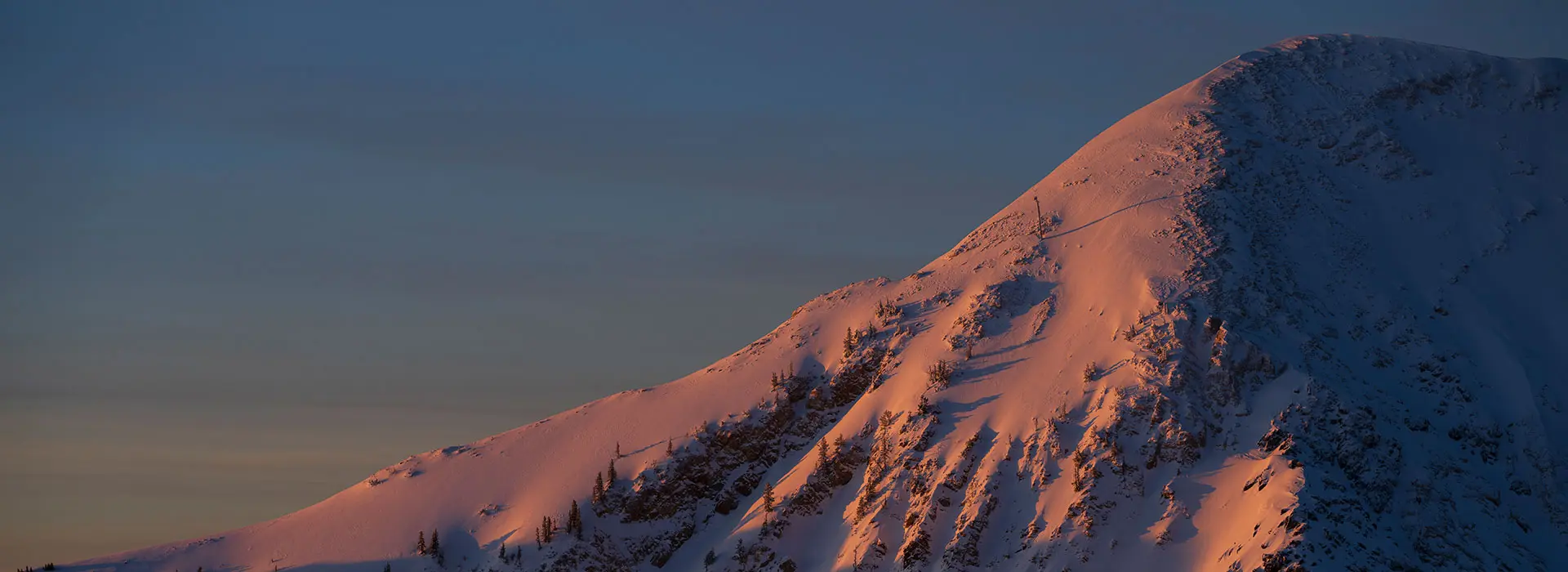
I kick around between ice and rock to find a solid hold for my ski boot. My ski partner takes the lead up the ridgeline, chatting away happily while I am only half listening out of determination to keep my focus. Bootpacking along the ridgeline leading to The Twins is a unique experience—as I walk methodically, a few precarious moments require bursts of bravery while more mellow trails, like Path to Paradise and Road to Provo, sprawl out just below.
Time passes quickly, yet slowly, as I march step by step. Upon reaching the summit of The Twins, a panoramic view of the Wasatch Mountains stretches out against the cerulean sky in front of me and the challenging bootpack suddenly proves worth it. But it’s not over. Just as I’m feeling comfortable and on top of the world, the real crux of the mission comes: a rocky downclimb onto an exposed, wind-scoured shoulder. At this moment, I decide to put on my crampons, benefitting from the little boost of confidence the spikes provide. Control, focus and preparedness is of the utmost importance for those hoping to ski Pipeline at Snowbird.

The Lore of a “Forbidden Fruit Chute”
Pipeline Couloir is undoubtedly one of Little Cottonwood Canyon's most visually stunning ski lines. The Chuting Gallery: A Guide to Steep Skiing in the Wasatch Mountains by Andrew McLean categorizes it with the “Forbidden Fruit Chutes,” a collection of 8 ski descents protected and managed by private ski resorts. The line slopes an average of 42 degrees with a vertical descent of 750 feet, excluding the apron. You don't have to look far if you’re ever searching for it from the top of Hidden Peak. You’ll know it when you see it.

Pipeline has been a part of Snowbird’s terrain since its opening in 1971 and protocol to make the pilgrimage to the top of The Twins has remained relatively unchanged for 50 years. Records show that it was skied for the first time by Junior Bounous and Jim McConkey; however, rumor has it that a woman named Dolores LaChappelle was the first to take the plunge down Pipeline before Snowbird opened. It is said that Dolores had many first descents in the Wasatch—including “Dolores Chute” in Snowbird’s Thunder Bowl.
So You Want to Ski Pipeline…
As a requirement to ski or snowboard Pipeline, or any line off The Twins, you must check in with Snowbird Ski Patrol first. There are several reasons why you should check in with ski patrol if you are going beyond the typical boundaries of the resort, but in the case of The Twins, you must sign a waiver. In addition to the willingness to sign a waiver, you must prove to ski patrol that you have the following:
- A partner
- An avalanche transceiver (also known as a “beacon”)
- A shovel
- An avalanche probe
Calling the Shots
I had the opportunity to meet and chat with Eric Murakami (“Kami” for short), the Director of Snow Safety at Snowbird. Eric has been patrolling in the Wasatch for 26 years, 18 of which have been dedicated to serving The Bird's steep and rugged terrain. Before delving into the details of Pipeline itself, I wanted to understand more of his day-to-day, especially what it looks like to oversee snow safety at a resort known for its high percentage of avalanche-prone terrain.

After spending time with Kami, my rough comprehension of the process of avalanche mitigation is as follows:
- Patrollers set out between 4:30 and 6 am to lay of the land and begin avalanche mitigation work.
- At that time, at least two snow safety team members begin their day, drafting write-ups and receiving intel about what happened overnight, as well as weather forecasts for the day.
- Observations are then sent to both the Utah Department of Transportation (UDOT) and Utah Avalanche Center, followed by another round of observations at around 3 pm.
- Using data from the day and overnight weather forecasts, an action plan for avalanche mitigation for the following day begins to take shape around 4 pm that evening and the process repeats itself.
Is Pipeline Open?
While ski patrol and snow safety recognize that skiing Pipeline is an incredible experience, its mitigation falls lower on the list than Snowbird’s primary terrain. For it to open, not only do conditions have to be just right—they also need to be consistent.
“Typically, if we’re going into a high-pressure system, we start the dialogue about opening up Pipeline for that week,” Murakami remarked. “It’s a serious operation. We need to get patrollers up there to evaluate the conditions. Sometimes by helicopter and often conduct avalanche mitigation with hand-charge explosives and projectiles.”
Because of this, Eric and his team need to decide early on whether or not timing and resources align to work toward opening Pipeline. If the window looks good—for example, 3 to 5 days of clear skies and high pressure—it’s game on. Once mitigation is complete and Pipeline has been cleared to open, it’s anybody’s game if you play it right.
The alluring thing about Pipeline is that Snowbird won’t tell you when it opens. This has built up an air of mystery and intrigue around this “Forbidden Fruit Chute.” You can’t find it under the terrain status online and won’t receive any sneaky hints through Instagram. This isn’t because Snowbird wants to keep secrets from you—it’s because the nature of Pipeline is such that its status can change from “open” to “closed” at a moment’s notice. If you want to ski Pipeline, you must be in the right place at the right time. Often, this means boarding the first Tram of the day at 9 am. It’s a unique experience, feeling like you’re doing something so special within the confines of this already renowned ski resort. To find out if Pipeline is open, check in at Snowbird Ski Patrol’s office at The Summit and remember to be respectful of the ski patrol and snow safety teams when you stop by.
Worth the Wait

I cannot stress enough the magnificence of this couloir. I’ve seen it written that if you have the opportunity to ski Pipeline, “You’ve earned bragging rights for the rest of the day.” That’s certainly how I felt after skiing the cold snow within this stunning couloir, still protected days after the last storm. If you, too, want to ski Pipeline, come prepared with good timing, the right gear, a partner and be ready for a long walk—you won’t be disappointed.
About the Author
Nina Groom
Nina Groom is a Massachusetts native who fell in love with the Wasatch Front. Over the past few years she has worked as a hiking/backpacking guide, freelance content creator and social media manager. Before spending most of her days in the mountains, Nina spent the majority of her time both on and off stage in the theater.