

Powderbird Helicopter Skiing
Powderbird Helicopter Skiing
Powderbird Helicopter Skiing

Powderbird FAQs
Plan your trip.
Get ready for your day with Powderbird. The most common questions about helicopter skiing and snowboarding can be found here. Feel free to contact us with any additional questions you may have.
Why Powderbird?
Established in 1973, Powderbird Helicopter Skiing has evolved into a helicopter skiing operation like no other. With our luxurious heliport base just a short 45-minute drive from Salt Lake International Airport, Powderbird is the most accessible helicopter skiing operation in North America. Focusing on small group heli-skiing adventures, Powderbird has developed a program that offers guests the utmost flexibility. From individual seat reservations to Multi-Day Packages to Private Group excursions, Powderbird has the team and the helicopters to make your backcountry dream a reality.
Are snowboarders allowed?
Yes, snowboarders are welcome at Powderbird.
How good of a skier do I have to be to heli-ski?
Helicopter skiing is not an activity reserved for professional “extreme” skiers. Most accomplished skiers and snowboarders, who are comfortable skiing black and double black diamond runs in the resort, have the necessary skills to heli-ski. Powderbird guides will match your ability level to our broad mix of terrain, from gentle ridges and bowls to steeper adrenaline-pumping chutes and runs. Perfect style and technical expertise are not prerequisites, but the ability to control your speed in a variety of snow conditions is critical. There may be trees and other natural features that are more challenging than on the maintained slopes of a ski area. It is necessary that you are proficient at kick-turning, traversing and side-slipping. These skills will help you handle anything you might encounter. Snowboarders must be able to traverse and carry their speed across flats. To fully enjoy helicopter skiing, you should have previous soft snow/powder experience and enough endurance to ski a full day at a moderate pace.
Though we try to access the best snow available, occasionally, there are sections of tricky conditions, such as heavy snow or crust. Tricky snow can often be more easily maneuvered if you are on the newest generation of skis or backcountry snowboards.
Please Note: Once the helicopter leaves the base, it does not return until the end of the day. If you are flown in early for any reason, you will be charged for the full day of skiing, plus the cost of the fly-in.
Do I have the fitness level to helicopter ski or snowboard?
For advanced and expert skiers or snowboarders, heli-skiing is no different than skiing off-trail at your local resort. However, there are a few things to consider:
- Do you feel confident that you can ski or ride a full run at a moderate pace with minimal falls?
- Do you feel comfortable skiing or riding on most black and double black runs, top to bottom with limited or no stops?
- Do you have experience skiing or riding at elevation?
- If you have a pre-existing medical condition that may be exacerbated by exercising at elevation, do you feel it is manageable?
If you answered yes to all of these questions, you should be well-suited to fly with Powderbird.
What is your weight policy?
It is very important that Powderbird has accurate client weights for the helicopter, as loads are based on the weights you provide. You will be weighed on the day of your trip. Please be sure and give an exact and accurate weight when booking your reservation. If your weight differs significantly from the weight given you may be declined participation but will still be responsible for the price of the seat.
Sometimes the total weight of a group may preclude group members from flying together in the same load. Although every member of your group may not fly together, Powderbird will make every effort to allow you to ski together. Heavier individuals are often paired with lighter individuals to minimize the total load weight in the helicopter. Groups comprised of all large individuals and individuals over 225 pounds may not be able to be sufficiently paired together and should be prepared to purchase either part of, or an entire portion of, an additional seat.
What happens if there is a flight delay or bad weather?
If we don't have the weather clearance to take off, we simply begin the morning with our guided in-resort skiing at Snowbird. If the weather clears up before the afternoon, we will shift gears and be ready to get in the helicopters. On the days we know it's not clearing up, we start the day with a breakfast and brief then head out for guided in-resort skiing at Snowbird. After spending the day on the snow we head back to the Powderbird Heliport for aprés-ski appetizers and drinks. At Powderbird we are committed to providing access to a legendary experience each time you join us for a remarkable day of skiing, regardless of the weather.
When is the best time to heli-ski?
People often ask, “When is the best time to go heli-skiing?” The short answer to this question is whenever possible. In Utah, there is the possibility of powder from December 15 through April 15. However, there are some other variables to consider when booking your heli-skiing trip:
Early Season: December 15th-January 15th is considered early season as it provides the year’s first significant snowstorms. Depending on the year’s snowfall, operation can be limited as we pick out terrain that has ample coverage. However, if preseason snowfall is strong, this can be a great time to take advantage of large storms that often frequent the region.
Peak Season: January 15th-March 15th is our peak season. While conditions can vary throughout the season, this time of year generally offers the most consistent and reliable conditions for helicopter skiing. For guests joining us in January and February, the lower sun angle and shorter days cause cold temperatures, thus preserving the snow many days after a storm.
Late Season: Guests joining us in March are often greeted by warm temps and a monsoonal flow that brings large storms to the area. March 15- April 15 is considered late season. During this time of year, conditions and temperatures can vary widely. From intense spring storms that bring multiple feet of snow to the mountains to warm high-pressure systems that create perfect corn conditions. Guests joining us this time of year may experience a variety of conditions in a single trip.
Can I fly standby?
You can join Powderbird's standby list to receive text messages about availability on upcoming flights. To join the standby list, fill out the form:
What do I need to pack for a day of heli-skiing?
What you need to pack for a day of heli-skiing is what you would normally bring to a day of skiing at the resort including clothing, helmet, goggles, boots, poles and skis or a snowboard. The avalanche airbag you will be issued for the day is only 10L so you will not be able to bring too many items.
Skis: Powderbird provides demo K2 skis for your day in the mountains. You will need to bring your own boots. Boot rentals are available for an additional cost from Snowbird's Rental Shops.
Snowboards: Powderbird does not have Snowboard demos available. Snowboard equipment can also be rented from Snowbird's Rental Shops.
Avalanche Rescue Equipment: Powderbird provides all the avalanche rescue equipment you need.
Snacks: Powderbird provides snacks and water for your day in the backcountry. However, if you would like a specific snack while skiing feel free to bring it.
Camera: Bring your GoPro or camera to capture your powder turns.
Medication: Please bring any medication or medical devices you may need, including epipen or inhaler. Please let our guides and staff know about these pertinent items.
Long story short you do not need to bring many things outside of what you would normally take with you skiing at your local hill.
What clothing is appropriate for heli-skiing?
It is always recommended to dress in layers for your day of heliskiing. You can always take a layer off and stash it in the helicopter or in your avalanche airbag that you will be issued for the day. Here's a list to get you started:
- Base layers, such as long underwear and a long-sleeve shirt
- Upper body mid-layer, such as a puffy jacket
- Outer shell
- Gloves or mittens
- A face buff
- A helmet
- Goggles
Do I need avalanche safety and rescue gear?
Powderbird provides each client with an avalanche beacon, shovel, probe and and avalanche airbag for their day of heliskiing. Clients who wish to use their own avalanche rescue gear may do so. The guests's avalanche rescue gear will be inspected by their guide to ensure good working order and functionality; guests will also have to sign an additional waiver.
How many other riders will be in my group?
For Individual Seat guests, you will ski and fly in groups of 4 with 1 Powderbird expert guide. Occasionally, you will be joined with another lift and will ski/ride with a larger group size of 8 with an additional Powderbird expert guide.
For Private Group guests, your helicopter can accommodate a group size of 1-8 skiers/riders and you will not be joined by anyone outside your group. If you have a larger group size, please ask Powderbird office staff to inquire custom heli-ski days.
How many guides will be in my group?
Each group of 4 will be accompanied by 1 guide. Typically, groups consist of 4 guests and 1 guide, although we may combine groups in some cases. In that instance, there will be 2 guides for a group of 8.
What kind of helicopters do you fly?
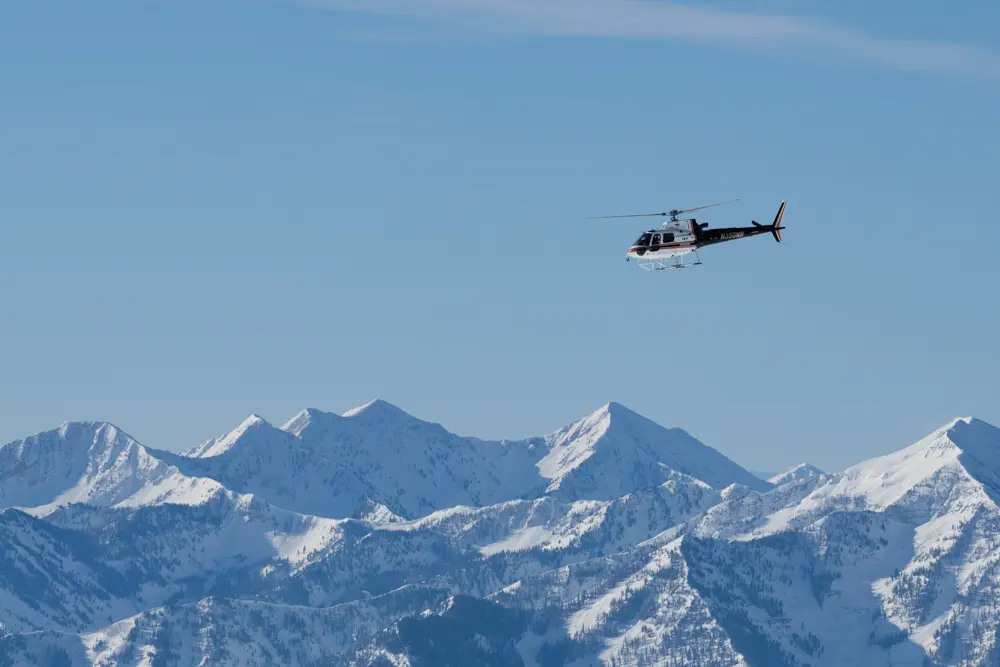
Powderbird flies the Airbus H125, formerly known as the AStar AS350 B3e, which is an intermediate single-engine helicopter.
Is heli-skiing safe?
Heli-skiing comes with inherent risks, and your understanding of the risks is very important. The environment you will encounter is uncontrolled and contains potential hazards that can cause injury or death. Our guides and pilots are highly trained to reduce those hazards, but incidents can still occur. It is of upmost importance that every guest pays close attention to our safety training each day they join us and follows the guide's and pilot's instructions closely throughout their day.
Where is the best heli-skiing in the world?
There are many amazing places to helicopter ski in the world. The Utah location where Powderbird operates has distinct advantages.
Utah is considered to have some of the best snow on earth, with unparalleled accessibility and convenience. The heliport is 30 miles from the Salt Lake City International Airport and is surrounded by Snowbird's luxury hotels. With an average of 500" of snow a year, Little Cottonwood receives some of the most snow (if not the most) in North America.